
What’s Working in eCommerce Advertising Right Now (Q1 2026)
March 4, 2026
1 Min Read
Earlier this year, we hosted a Q1 breakfast briefing for eCommerce brands and the Bristol Beacon. Together, we explored how…
Read ArticleFebruary 18, 2026
9 Min Read
Paid Media


Senior Account Manager
Sign up to stay in touch and be the first to hear about our latest business, market and event updates.
Once upon a time, advertising on Meta was all about finding the audience. Nail your interest, include a lookalike audience (LAL) or 2, and let the ads run.
But with its Andromeda update, Meta has fundamentally (and relatively quietly) changed how ad targeting works on its platform. In short, Andromeda has ripped up the playbook in front of our very eyes, ringing in the era of creative-first advertising.
In this guide, we explain what Andromeda is, how it works, what it changed, and how it changes the way advertisers approach strategy on Meta.
💡Further reading: How AI Personalisation is Changing eCommerce Advertising
Andromeda is Meta’s next-generation AI advertising system. It uses machine learning (ML) to determine which ad each person sees at any given moment across Facebook, Instagram, Messenger and the wider Meta network.
At a technical level, Andromeda is a retrieval and ranking engine. Its job is to scan a pool of potential ads, predict which one is most likely to drive the desired outcome, and serve it in real time.
Where earlier versions of Meta’s ads infrastructure evaluated thousands of ads in an auction, Andromeda can evaluate millions. This dramatically increases the number of potential ad-to-person matches the system can consider before making a decision.
But while the engineering is impressive, the strategic shift is where advertisers should focus.
With the rollout of Andromeda, Meta has shifted away from audience-first advertising and toward creative-first matching. Targeting has become less deterministic, and the system is far more interested in what your ad is actually saying than carefully curated audiences.
Historically, Meta advertising was built around audience selection. Advertisers defined interests, behaviours or lookalike segments, and the system delivered ads within those boundaries. Andromeda flips that logic. Instead of starting with audiences and finding ads to fit them, the system starts with ads and predicts who they will resonate with.
In practice, this means your creative, messaging, product signals and landing experience now carry far more weight than your manual targeting inputs. Every ad is a bundle of signals that the system uses to determine relevance at the individual level.
Before Andromeda was announced back in December 2024, and subsequently rolled out (a process that was fully implemented by October 2025), advertising on Meta was largely about targeting by constraint.
As advertisers, we defined audiences, split campaigns by segments, and tried to control delivery through targeting logic. Performance improvements often came from tighter structures and more granular optimisation.
Andromeda shifts that dynamic. Instead of relying on predefined audience buckets, the system now evaluates ads at the individual level, using predictive models to decide who is most likely to respond in that moment.
You can see this shift most clearly in products like Advantage+ Shopping campaigns. These campaigns deliberately remove much of the traditional setup and rely on Meta’s AI to handle delivery decisions.
In short, Andromeda does the targeting for you. The new lever is creative.
If you take one thing away from reading this, it should be this: Andromeda represents a paradigm shift in targeting. You need to change how you think.
Andromeda is powered by machine learning algorithms. It operates a “multi-stage ads recommendation system”, selecting ads from “tens of millions of ad candidates”, before using ranking models to “determine the final set of ads” the user sees based on value.
This decision is made by assessing the likelihood of different outcomes: a click, a purchase, or a meaningful engagement based on signals like creative, user behaviour, historical performance patterns, and real-time context.
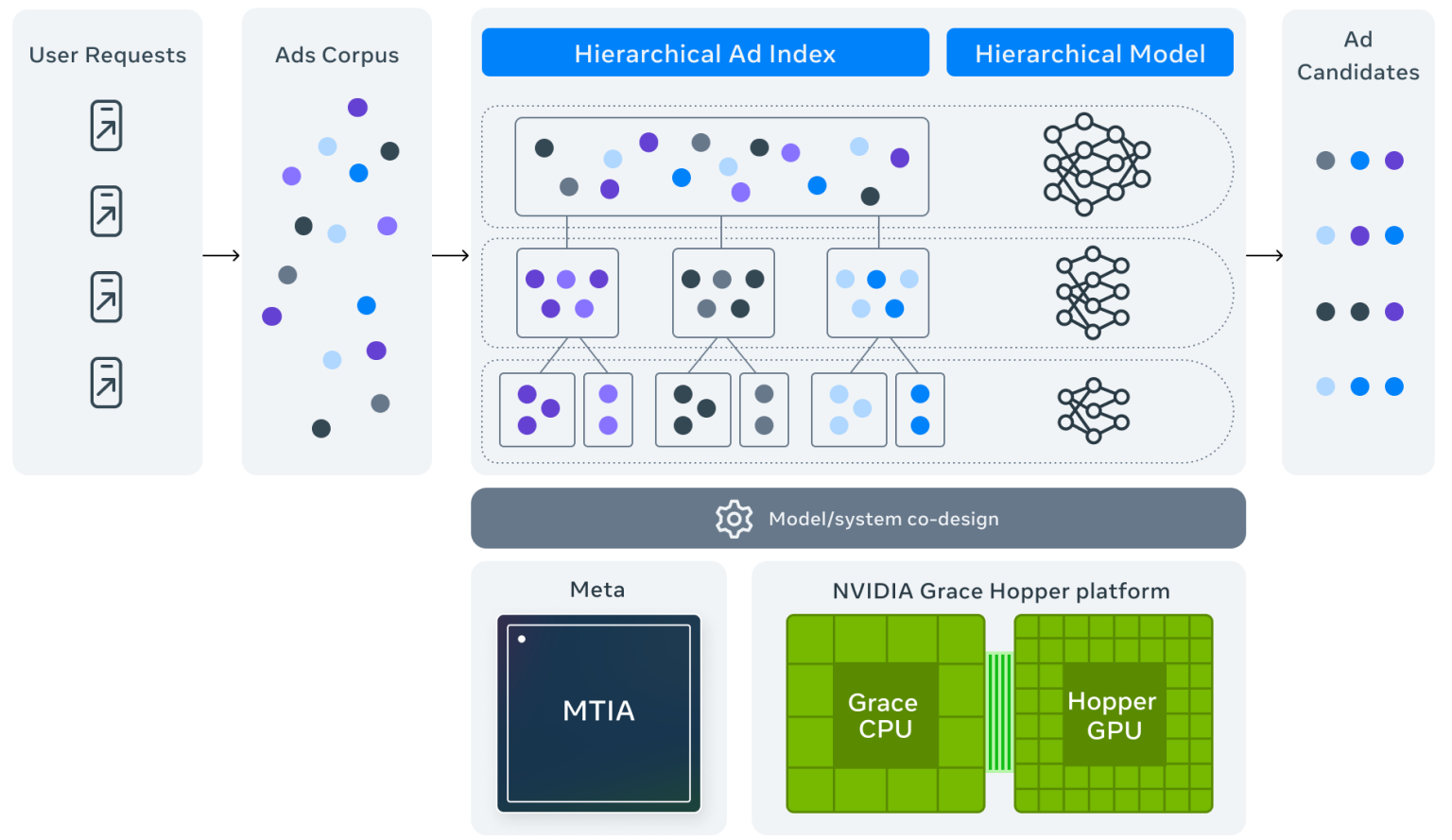
Instead of evaluating a small auction set, Andromeda can scan millions of potential ad matches in fractions of a second. It continuously updates its predictions as new performance data comes in, allowing delivery to adapt dynamically over time.
It’s basically a prediction engine. And creative is the signal advertisers have the greatest control over.
Andromeda’s AI thrives when it has a big playground. The more room it has to explore – it can assess millions of datapoints – the better it gets at matching ads to people. Over-segmenting campaigns or tightly locking down audiences just shrinks the opportunity pool.
What this means in practice:
For advertisers, it’s less about deciding who an ad is for and more about using data to find out where it resonates (who it is actually for).
If you’re still hunting for that winning ad, Andromeda has some news for you: it would rather you didn’t. Performance now comes from sheer creative variety, not creative perfection.
Strong accounts tend to include a mix of visually distinct assets, which may include:
Each creative speaks to a different mindset. Andromeda figures out which one to serve, when, and to whom. Think of it less like choosing a single outfit for every occasion, and more like packing a well-thought-out suitcase.
“Where do Dynamic Product Ads fit in?” I hear you ask.
They used to have a pretty simple job: follow users around the internet with the exact thing they just looked at. Effective? Yes. Subtle? No.
In the Andromeda era, dynamic product ads (DPAs) are getting a freshen up. They’re increasingly used not just for retargeting, but for:
The system doesn’t just decide which product to show – it also decides which user should see which product, and in what context.
Add in different catalogue image styles, lifestyle treatments, and copy variations, and DPAs become a surprisingly powerful discovery tool. Still dynamic. Just… smarter.
If this all sounds like “let the AI do everything,” don’t worry – advertisers are still very much needed. The job has just adapted.
The new role is less about control and more about curation:
Instead of telling Meta exactly who to target, you’re telling it what you’re offering – and letting it handle the matchmaking.
Think back to the signals Andromeda looks at: creative, user data, and historic performance. Which is the one most within the advertiser’s control?
Creative is becoming the single biggest performance lever on Meta.
In the past, it was all about audience strategy. Whoever matched a few bits of creative to a defined audience as well as possible – tweaking here and there – usually won.
With Andromeda, most of that data is set. But what advertisers do have control over is supplied creative. And the more variety you give Andromeda, the more individuals you are likely to see success with.
One person may respond to a product demo. Another may prefer lifestyle imagery. Someone else might only convert after seeing a price-led offer or testimonial. Andromeda can identify these patterns far better and more quickly than a human.
But it needs volume and variety. The algorithm can only optimise what exists.
If you run a handful of near-identical ads, you’re giving Andromeda very little room to find winning matches. If you run a wide mix of formats, hooks, messages and visual styles, you’re giving it hundreds of potential pathways.
Andromeda is now deciding who sees your ads in the Meta ecosystem. The size and scale of the possibilities mean that success is more likely to come from volume and variety (better signals), rather than tighter control.
Lean into Andromeda as an opportunity. Here are five practical ways advertisers can adapt.
Andromeda is designed to match different ads to different individuals at scale. Everyone is different.
The more varied your hooks, formats and concepts, the more opportunities the system has to find winning matches. A handful of polished ads won’t outperform a diverse creative mix.
Over-segmented campaigns restrict learning. Consolidated budgets and broader targeting give the system more data to work with and improve its ability to find matches across audiences.
Products like Advantage+ Shopping are effectively the layer on top of Andromeda’s prediction engine. They remove manual friction and allow the AI to optimise placements, audiences and combinations dynamically. Accept the system and lean into it – your competitors are.
Creative is no longer just a brand asset; it’s the primary signal the system uses to understand who your ad is for. That means investing in ongoing production, testing multiple concepts simultaneously, and refreshing assets frequently. You need to get comfortable with iterating in public.
One of the most common mistakes advertisers make is not moving with the times. You can no longer run Meta ads as if nothing has changed. Your best competitors are moving on – you need to move with them. These are the common pitfalls we see:
Tightly defined audiences limit the system’s ability to discover demand, especially where it exists in unexpected places. Andromeda’s strength is volume and analysis; excessive segmentation simply starves it of learning data.
Andromeda can only optimise what you give it (for now). If your creative all says roughly the same thing, the system has very little wiggle room to find different audience-message matches.
Many advertisers still resist tools like Advantage+ because they’re a bit of a black box. In reality, they’re just exposing the same AI logic that now powers delivery anyway. Fighting automation often means fighting the system itself.
Traditional A/B testing focused on tiny tweaks. In the Andromeda era, the system learns faster from meaningful creative differences than marginal changes to headlines or colours. You may be surprised by which creative works well with an audience. You may discover a new audience entirely.
Because delivery adapts continuously, early results can be noisy. Killing campaigns or creative too quickly can prevent the system from finding the best performance for you. Let it learn.
Andromeda doesn’t mean targeting is dead. It means creative is finally doing the heavy lifting.
The advertisers who win won’t be the ones with the most complicated audience setups. They’ll be the ones who give Meta’s AI a rich, interesting set of ads to work with – and the patience to let it figure things out.
Because the big question has changed.
It’s no longer: “Who should I target?” It’s: “What range of stories, products, and messages am I putting in front of the system?” And honestly? That’s a much more fun problem to solve.
Photo by Guillermo Ferla on Unsplash