Scroll LinkedIn for two minutes. Go on. I’ll wait.
Chances are you’ve just seen 3 ads with a blue gradient, a stock photo of a handshake, and a headline that could belong to literally any company in any sector.
Nobody chose to make those ads. They just… happened. Shipped without anyone asking the hardest question: would I actually stop scrolling for this?
A few years back, I attended a webinar hosted by “The Marketing Meetup” with Richard Cook from Monzo Bank, “How to Stand Out on Social Media in ‘Boring’ Industries” – and it’s lived rent-free in my head ever since.
Because the problem isn’t the audience. It never was. The problem starts much earlier, in the brief, in the room, with the assumption that B2B buyers want to be spoken to like a terms and conditions page.
They don’t. And here’s the framework to prove it.
Why Most B2B Ads are Boring (And Why They Don’t Need to Be)
Here’s a stat worth keeping in your back pocket.
Brand Finance and System1 analysed B2B ads aired between 2020 and 2025 across four key categories (business software, services, accounting, consulting, banking) and found that 65% of ads in the business software and services category scored just one star out of five for emotional effectiveness.
Only 1.1% scored five stars. That means the majority of B2B advertising contributes more or less nothing to long-term market share growth. In other words, the brand is entirely reliant on outspending the category to be seen.
And the audience is noticing, because of course they are. Separate research has found that 82% of B2B decision-makers wish B2B advertising had the creativity of B2C, and 48% just find it plain old boring.
So, what’s going wrong?
Richard Cook works in banking; one of the most regulated, compliance-heavy industries going. Rules everywhere. Lawyers in every hallway. And yet his take was simple: compliant content can still be beautiful, funny, and inspiring.
If Monzo can make credit scores feel interesting on TikTok, you can make your SaaS product feel like something a human being actually had a hand in making.
The central misdiagnosis most B2B teams make is assuming the audience just demands safety. They don’t. That’s just what the brief demands. And it isn’t right.
And before anyone says “but B2B is different to B2C” – Richard had a line for that too: behind every B is a C. You’re still selling to a person. A tired, scroll-happy, mildly distracted person who has seen seventeen blue gradient ads today and remembers none of them.
There are no boring topics. Just boring content. And there’s a big difference between the two.
Five Reasons B2B Ads Underperform
Confusing “Professional” with “Risk-Averse”
“We’re a serious firm” translates to “do nothing distinctive.” But professional means competent and trusted, not beige.
Richard’s first point at that webinar has stayed with me: your customers are more creative than you. They have taste, opinions, and a pretty sharp eye for when they’re being talked at vs. talked to. The brief that mistakes seriousness for safety is the brief that disappears into the feed.
Designing for the C-Suite, Missing the Gatekeeper
B2B buying is committee-led. The C-suite signs the contract, but a Marketing Manager, Head of HR, or Head of Procurement was the first person to forward your name.
If your creative is only speaking to the decision-maker, you’re skipping the person who actually puts you in the conversation. Speak to the humans doing the legwork, in their language, not in the language of a quarterly business review.
Treating the Audience as Job Titles, Not Humans
LinkedIn’s targeting reaches roles. That only gets you so far. Your ad needs to reach the person inside the role.
A Head of Finance at 5 pm on a Tuesday is not sitting there craving a whitepaper. They’re scrolling, half-distracted, one thumb moving – just like everyone else. There are no boring topics, only boring content. The ad that remembers there’s a person behind the job title will always outperform the one that forgets.
And the numbers back up what we’re saying here. LinkedIn’s own 2025 Creative Labs study analysed 13,000 B2B video ads and found that workplace humour, memes, pop culture references – things that actually feel native to the feed – drove engagement up by as much as 111% for meme formats and 41% for pop culture references.
Authentic, human-feeling content outperformed polished corporate filler by 78%. The platform telling you who to target is also telling you – using research – how to talk to them. It’s probably a good idea to listen up.
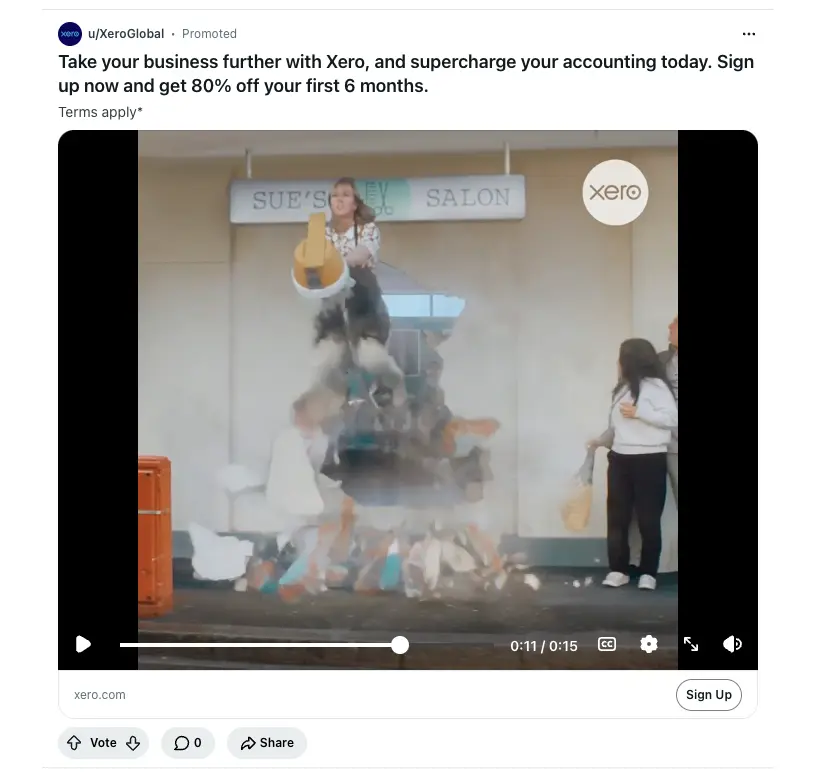
Xero’s Reddit ads are a great example of getting this right. Instead of speaking like accounting software, they lean into platform-native humour and meme formats that actually feel like Reddit. The targeting might be B2B – but the creative understands it’s still talking to humans.
That’s the difference between advertising at an audience and communicating with them.
Optimising for Brief Approval, Not the Feed
Every sharp edge gets smoothed in review. Every bold choice gets questioned until it isn’t bold anymore. The result wins the internal meeting – and loses the auction.
The real audience is never in the room when the creative gets signed off. The feed is the client. It’s just never invited to the presentation.
Mistaking Volume for Performance
Six versions of the same flat asset isn’t creative testing. It’s volume testing. Real creative variety means genuinely different and distinct concepts, different formats, different emotional registers – then actually reacting to what the data is telling you. That’s where performance creative comes in. Implemented properly, it’s one of the most impactful levers in the arsenal of paid teams today.
React to what’s happening. Cut what isn’t working for your audience. Lean into what is, and the algorithm (and your customers) will reward you.
Paid media platforms are increasingly making this decision for you in any case; Meta’s Andromeda system now uses creative signals to decide what gets shown to whom in real time, which means weak creative doesn’t just fail to convert, it fails to even compete in the auction.
B2B Case Study: Avison Young
Our brief for working with Avison Young was to launch its brand-new decarbonisation service for the UK real estate market. On LinkedIn. With no prior paid media activity to learn from.
Decarbonisation, real estate and LinkedIn definitely sound like a recipe for the previously mentioned blue-gradient-ad-with-a-handshake-stock-photo.
Avison Young’s decarb service brings together feasibility, fit-out, funding advice, and facilities management under a single clear contract. It’s a differentiated offer in a market where most competitors only focus on strategy.
Treating the Audience Differently
The audience was, of course, classic B2B. Industrial occupiers, landlords, and senior real estate decision-makers. Commercially valuable and notoriously hard to reach. And, like everyone else on LinkedIn, half-distracted on a Tuesday afternoon.
So, we took our own medicine and treated the audience like the humans they are, not the job titles the targeting filter says they are.
The creative concepts were built to earn attention in the feed, not to simply guarantee stakeholder approval. At the end of the day, any brief boils down to actually achieving the results and stimulating growth.

Differentiated Creative Testing
To achieve this, all our testing involved different ideas – different formats, different angles, different emotional messaging appealing to different audiences – and then we reacted quickly to what we were seeing in the results.
Over a ten-week burst, the campaign reached 78,000 senior decision-makers at priority companies and drove a +476% uplift in sessions to the decarb service pages.
Not only that, but a bank of high-value leads landed with the Avison Young sales team. And, perhaps most importantly, they now have a tested foundation of learnings and data, a proven ad format, and a validated audience approach to scale from in future.
Decarbonisation isn’t a boring topic. But the ads about it usually are. And that’s the gap we aimed for that ultimately delivered success.
There are no boring topics. Just boring content.
B2B buyers are not a different species. They’re the same people who share things that make them laugh, remember brands that surprised them, and forward the email that felt like it was written for them specifically.
The brief is where boring starts. And it’s exactly where interesting can start too. B2B ads don’t need to be boring – they just need someone in the room willing to say so.
Photo by Rock Staar on Unsplash